

Once upon a time, home appliance giants built their “empires” with traditional home appliances such as air conditioners, refrigerators, and washing machines. Now, they have all joined the brand – new field of robotics, attempting to carve out a new world beyond the home appliance market with slowing growth.
However, can these traditional home appliance giants achieve their goals?
Home Appliance Giants Flock to Robotics
Currently, in the path of home appliance enterprises to open up “new battlefields”, AI and robotics are the hottest areas. Traditional giants like Midea Group and Haier, as well as cross – border players like Xiaomi, almost all regard the robotics field as an important direction for transformation.
However, behind this upsurge lies the common growth anxiety dilemma of home appliance enterprises.
The current large home appliance market has long entered the stage of stock competition. The replacement cycle of products such as refrigerators and air conditioners is generally as long as five to ten years, leaving less and less incremental market space for enterprises. Moreover, there have been a continuous emergence of cross – border and emerging home appliance brands in recent years.
Data from the National Bureau of Statistics shows that in 2024, the cumulative main business income of China’s home appliance industry was 1.95 trillion yuan, a year – on – year increase of 5.6%. But in fact, this is also due to the short – term stimulation of consumption demand by policies such as national subsidies and trade – in programs. In the long run, although the industry is growing, the growth pressure is obvious – for example, the cycle laws of various industrial lines are different, the “price war” is fierce, and consumers’ consumption desire is not high. Some industry insiders even claim that the home appliance industry has become the most competitive one.
In contrast, the robotics industry presents a different picture. According to CCTV.com, in the first half of this year, the production of industrial robots and service robots in China increased by 35.6% and 25.5% year – on – year respectively. As of now, there are more than 930,000 robot – related enterprises in China. Among them, more than 100,000 new related enterprises were added in the first half of this year, an increase of about 45% compared with the same period in 2024.
Facing the stagnant red – ocean market and the rapidly expanding blue – ocean market, robotics naturally becomes the new target of home appliance enterprises.
Coincidentally, there are some commonalities in the underlying technical logic between robotics and home appliances. For example, the sensors and AI algorithms required by some robots belong to the same intelligent hardware technology system as the intelligent control and frequency conversion technology of home appliance products. The technical foundation accumulated by home appliance enterprises over the years can be reused.
Therefore, home appliance enterprises that can hardly find growth space have to turn to new sources, and the robotics field happens to be that seemingly fertile low – lying land.
However, the path for home appliance giants to enter the robotics industry is not smooth.
Home Appliance Giants Face Their Own Challenges
Midea Group’s exploration in the robotics field can be traced back to 2017. In that year, Midea Group successively acquired Germany’s Kuka Robotics and Israel’s servo system company High – Tech, thus officially entering the industrial robot and automation market. In 2022, Midea Group successfully completed the full acquisition and privatization process of Kuka.
Source: Company announcement
Source: Company announcement
When Midea Group spent a huge amount of money to acquire Kuka, the outside world generally expected Midea Group to master the core technology of industrial robots and quickly enter the high – end market. However, from the actual performance, the effect of this technological marriage has not met expectations.
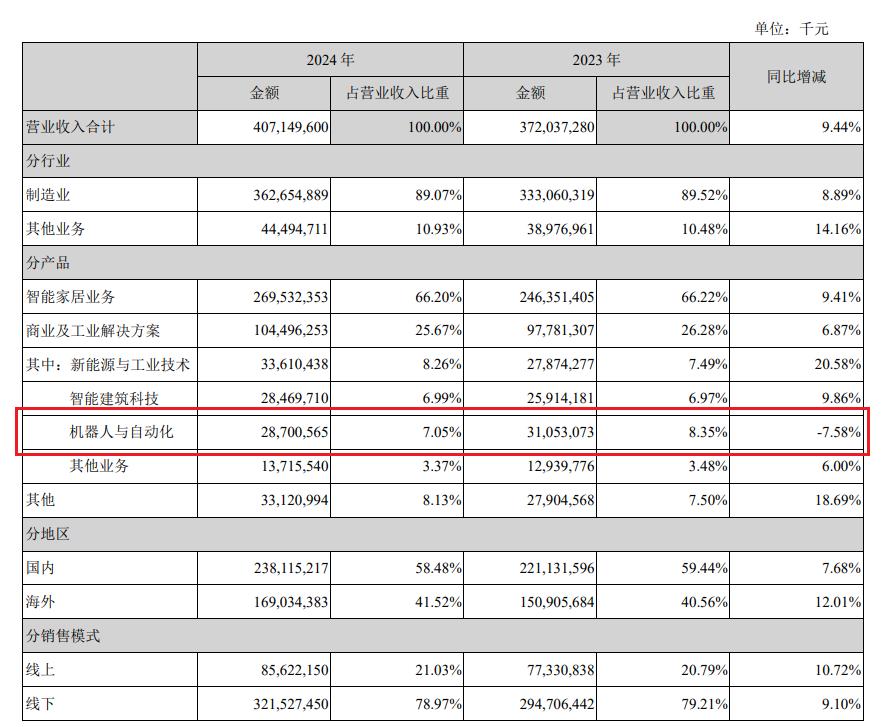
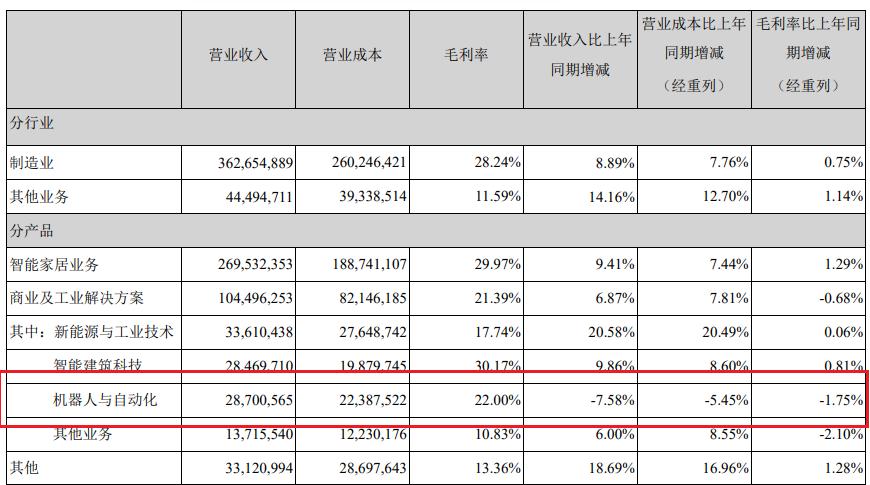
Midea Group’s 2024 annual report shows that Midea Group’s overall performance is outstanding, with an operating income of 409.08 billion yuan, a year – on – year increase of 9.4%; the net profit attributable to the parent company was 38.53 billion yuan, a year – on – year increase of 14.2%. However, the annual income of its robotics and automation business was 28.7 billion yuan, accounting for only 7.05% of the total revenue, a year – on – year decrease of 7.58%, and the gross profit margin decreased by 1.7 percentage points year – on – year.
Midea Group explained that affected by the periodic fluctuations in industry demand, such as the slowdown in the growth of the global new energy vehicle industry and the capacity adjustment of the photovoltaic and lithium – battery industries, the market demand for industrial robots was under short – term pressure, resulting in a decline in the revenue of this business.
Kuka’s performance has been volatile. Its revenue continued to decline from 2017 to 2020, and it even suffered a loss of 100 million euros in 2020, dragging down the overall robotics business revenue of Midea Group. Even though it recovered somewhat after 2021 and its market share in the domestic market increased to 8.2% in 2024, compared with domestic brands such as Estun and Inovance Technology, its growth momentum is still weak.
Although Midea Group has continuously increased its R & D investment, with a cumulative investment of more than 65 billion yuan in the past five years, including more than 16 billion yuan in R & D investment in 2024, the performance fluctuations of Kuka after the acquisition still arouse the outside world’s doubts about the sustainability of Midea Group’s robotics strategy.
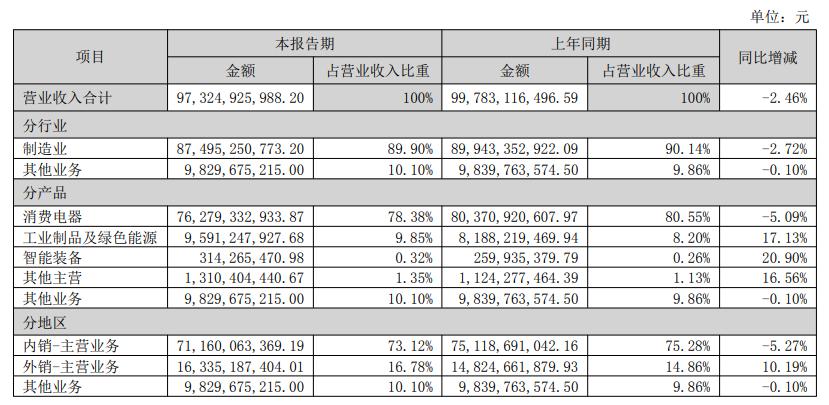
Among the major home appliance giants, Gree’s layout in the robotics field is obviously lagging behind. Although Gree launched its robotics business as early as 2017, currently Gree’s robotics business is concentrated in the industrial field and is mainly for self – use, with a very low proportion of external sales. In terms of performance, in the first half of 2025, the revenue of Gree’s intelligent equipment segment was only 314 million yuan, accounting for 0.32% of the total revenue in the same period.
Source: Company announcement
Gree claims to have overcome the core technologies of drives and reducers and achieved full coverage of robots with a load of 1kg – 600kg, but its market presence is still weak. MIR data shows that in 2024, Gree did not make it into the top ten in either the domestic industrial robot market or the personal/home service robot market share rankings.
At the same time, there are no representative Gree products in popular consumer – grade market categories such as floor – cleaning robots and window – cleaning robots. Analysis suggests that Gree has failed to keep up with the pace of intelligent transformation and has fallen behind its peers in the robotics field.
Compared with Midea Group and Gree, which focus on the industrial field, Haier focuses more on the home service robot market. Haier Smart Home has continuously expanded its exploration in the robotics field by acquiring Qingdao Tabool Robotics and cooperating with Leju Robotics, and exhibited the first domestic general – purpose service humanoid robot “Kuafu” for home scenarios this year.
Recently, Haier also launched the “HIVA Haiwa” home robot. This robot is 165 cm tall and weighs 70 kg, and is claimed to be able to perform various household tasks with 44 degrees of freedom.
However, there is a gap between ideal and reality. According to public information, “HIVA Haiwa” is currently remotely controlled by engineers and does not complete tasks autonomously.
In the promotional animation, Haiwa can run, turn, use a floor – cleaning machine, cook, and even interact intelligently with the washing machine to help fold and pick up clothes. These scenarios seem real, but currently this “housework terminator” is just a remotely – controlled actor, and the tasks it can actually do autonomously are pitifully few.
Of course, the home service robot market does have great potential. The latest data from the State Taxation Administration shows that in the first three quarters, the sales of smart home products increased rapidly. For example, the sales revenue of the service – consumption robot manufacturing industry such as floor – cleaning robots increased by 75% year – on – year. However, a real household robot needs to solve the three major problems of “perception”, “decision – making”, and “action”. If Haier wants to truly open up the market, it needs to solve the technological bottleneck.
At present, many enterprises are still in the stage of “fancy imitation”, showing “seemingly dazzling actions”, and the ability to make robots autonomously cope with the complex home environment still needs to be broken through.
Conclusion
Generally speaking, home appliance enterprises face some common challenges when entering the robotics field. The robotics industry emphasizes high – technology and high – craftsmanship, which requires long – term accumulation. It is almost impossible to achieve quick success. Moreover, this new industry of “heavy assets, heavy technology, and heavy ecosystem” is definitely not an industry that ordinary home appliance enterprises can easily enter.
However, the high threshold also means that this can only be a game for a few giants. The profitability of the robotics industry far exceeds the imagination of the current home appliance industry. Some industry insiders point out that compared with other consumer electronics industries, the home appliance industry has a large scale and a high degree of standardization. It is most likely to become the next industry to widely use robots after the automotive industry.
The robotics field is both full of temptation and full of thorns. Whether the robotics dreams of home appliance giants can come true still needs more time to polish.
This article is from the WeChat official account “Chief Consumer Officer”, author: Hasove, published by 36Kr with authorization.
link