
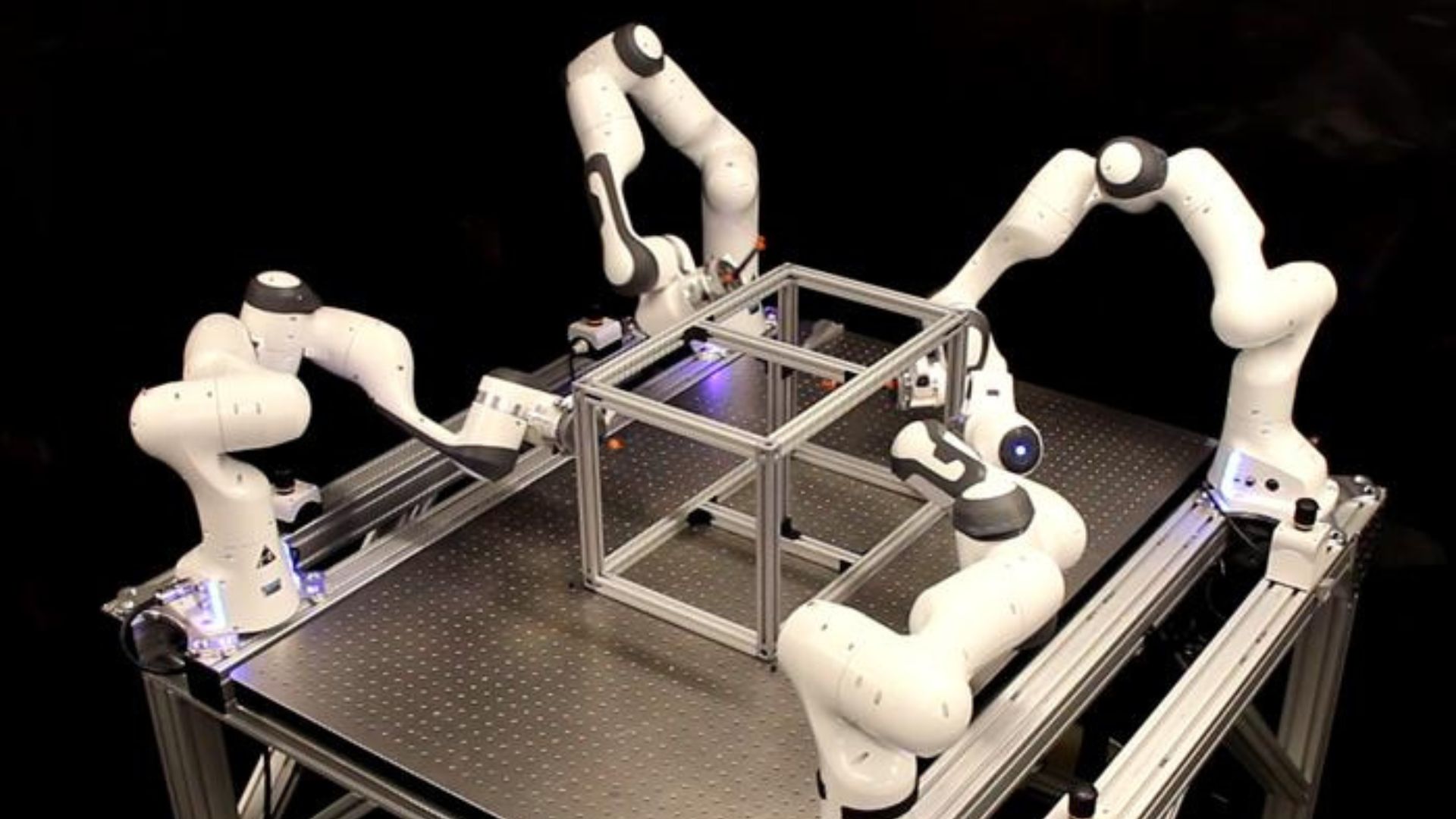
Coordinating fleets of robotic arms remains one of the toughest problems in modern manufacturing. On crowded factory floors, machines must share space with each other and with obstacles while working at high speed.
Today, that planning falls to human specialists who spend hundreds of hours programming robots to avoid collisions and complete tasks. The process is tedious, error-prone, and expensive.
A team from UCL, Google DeepMind, and Intrinsic has introduced an alternative. They have built an AI system called RoboBallet that can plan movements for groups of robotic arms in seconds.
By doing so, it promises to replace weeks of manual work and unlock new levels of efficiency.
The system combines reinforcement learning and graph neural networks. It learns through trial and error, earning rewards for finishing tasks faster.
The graph-based design allows it to treat obstacles and tasks as points in a network, which makes coordination easier to compute.
Lead author Matthew Lai, a PhD researcher at UCL and Google DeepMind, said, “RoboBallet transforms industrial robotics into a choreographed dance, where each arm moves with precision, purpose, and awareness of its teammates. It’s not just about avoiding crashes; it’s about achieving harmony at scale.”
In testing, RoboBallet solved up to 40 tasks with eight robotic arms, even in layouts it had never seen. It produced high-quality plans in seconds, a leap beyond previous planning systems.
Speed and scalability
Factories often grind to a halt if one robot fails or a layout changes. RoboBallet can adapt instantly, generating new plans hundreds of times faster than real-time. It also helps manufacturers decide where to place robots for maximum throughput.
Traditional planning tools collapse under the weight of complexity as more robots enter the mix.
RoboBallet avoids this trap by learning general coordination rules rather than memorising specific cases. That scalability, the team argues, is its major breakthrough.
Associate Professor Alex Li from UCL Computer Science said: “In today’s factories, coordinating multiple robotic arms is like solving a moving 3D puzzle, every action must be perfectly timed and placed to avoid collisions.”
He added that RoboBallet “could instantly generate plans for brand-new layouts at large scales and speeds that are impossible for specialists to handcraft.”
Future uses and limits
The potential applications stretch across industries. Car makers, electronics assemblers, and even construction firms could deploy teams of arms that operate together seamlessly.
For now, RoboBallet handles reaching tasks such as welding. Future versions could tackle pick-and-place operations, painting, or jobs involving strict task sequences.
The current version does not account for robots with different capabilities or every type of obstacle. The researchers say the flexible design should allow those features in future iterations.
Funded by Google DeepMind and Intrinsic, the project has also open-sourced its codebase.
That move could accelerate development and encourage wider adoption of AI-driven planning in robotics.
The study is published in the journal Science Robotics.
link