
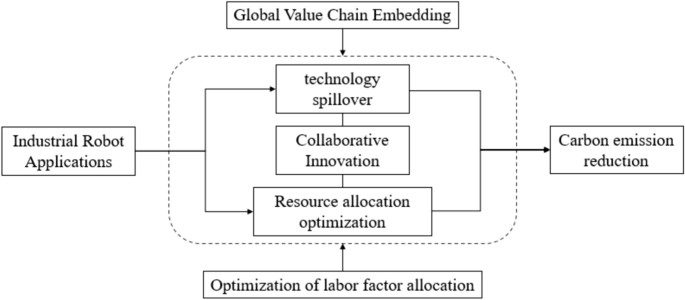
Benchmark regression results
This paper verifies whether the use of industrial robots has a significant impact on the level of carbon emission reduction based on Equation (1). The estimation results, based on a high-dimensional fixed-effects model, are presented in Table 3. The reported findings indicate that when we use only industry-level control variables without controlling for relevant fixed effects, the impact of industrial robot application on carbon emissions is significantly negative (see Table 3, Column 1). After incorporating country-level control variables, the coefficient for the application of industrial robots remains significantly negative (see Table 3, Column 2). The paper further controls for fixed effects at the country, industry, and year levels and uses clustered robust standard errors at the industry level to estimate the model. The results remain significant after adding industry-level control variables (see Table 3, Column 3). The addition of country-level control variables shows that the regression coefficients for the core explanatory variable, industrial robot application (lnRobot), are significantly negative at the 5% significance level (see Table 3, Column 4), consistent with the expected results and confirming Hypothesis 1. This indicates that the application of industrial robots in global manufacturing significantly reduces carbon emissions, thereby enhancing the level of carbon emission reduction in the manufacturing industry and proving that industrial intelligence is beneficial to green and sustainable high-quality development. The main focus of this paper is on the estimation results in Table 3, Column 4, which show that the application of industrial robots in manufacturing has a significantly negative impact on carbon emissions. For every 1% increase in the level of industrial robot use, carbon emissions will decrease by 0.02%. Compared with existing literature, this study provides empirical evidence for decarbonization development at the global manufacturing industry level and is similar to the empirical results of Yu et al. at the city level in China39. However, the results of this paper are slightly lower than those of Yu et al.39, indicating that the inhibitory effect of industrial robot use on carbon emissions in China is higher than the world average.
The estimation results of the control variables are also consistent with theoretical expectations. An increase in energy intensity and industry scale will greatly affect the level of carbon emissions40. Therefore, against the backdrop of the new technological revolution, manufacturing industry, as the main battlefield for the application of advanced technology, not only effectively curbs the growth of carbon emissions while greatly increasing output through the application of industrial robots in industrial production but also promotes carbon emission reduction to some extent.
Robustness checks
Variable substitution
-
(1)
Replacement of the Dependent Variable Measurement. In this paper, the dependent variable measuring carbon emission levels in the baseline regression is replaced with the logarithm of the ratio of carbon dioxide emissions to total industrial output (lnCI1), and the logarithm of the ratio of carbon dioxide emissions to the value added by the industry (lnCI2), respectively. Regressions are rerun based on Model (1), and the estimation results are presented in columns (1)-(2) of Table 4. The results show that changing the measurement of the dependent variable does not affect the core conclusion; the application of industrial robots in the global manufacturing industry continues to significantly reduce the carbon emission levels of various industries.
-
(2)
Replacement of the Measurement Indicator for Industrial Robot Application. This paper further substitutes the measurement method of the core explanatory variable to conduct robustness checks. (1) The predetermined variable of the number of employees in each industry in 2000 is introduced as an explanatory variable. The stock of industrial robots introduced in each country’s industry is divided by the number of employees in that industry in 2000, and the logarithm is taken to calculate the industrial robot penetration rate (lnlab). (2) The number of industrial robots used is divided by the labor force in each industry, and the logarithm, denoted as the industrial robot usage density (lndensity), is taken as a measure. Regressions are rerun based on Model (1). The estimation results are shown in columns (3)-(4) of Table 4, and it is found that the empirical analysis results of this paper remain robust.
-
(3)
Introduction of Variable Lag Terms. According to the baseline regression results, the application of industrial robots in the manufacturing industry significantly reduced carbon emissions. However, there may be a potential issue that industries with low carbon emissions, due to their production characteristics, may also deepen their investment in intelligent equipment to improve production efficiency and move into high-end manufacturing positions. This paper adopts a robustness strategy of lagging the core explanatory variable by one and two periods to overcome the potential reverse causality problem that may arise from this. The analysis results are in columns (5)-(6) of Table 4, and it is found that lagging the core explanatory variable still significantly reduces industrial carbon emissions, further corroborating the robustness of the core conclusion.
Endogeneity treatment
Considering that countries or enterprises with higher carbon emission reduction capabilities may have better production conditions and prioritize the use of industrial robots, the reverse causality leads to endogeneity issues. Additionally, the application of industrial robots may involve some unobservable factors, resulting in endogeneity issues due to omitted variables. These factors can affect the consistency of the estimation results. To address this, this paper employs the instrumental variable method to mitigate potential endogeneity issues.
The existing literature on the choice of instrumental variables for the application of industrial robots mainly falls into two categories. The first category uses the industrial robot installation density of similar countries and industries as an instrumental variable13. The second category constructs instrumental variables using the shift-share method, and the instrumental variables constructed with this idea are also known as Bartik instrumental variables, which have been widely used by scholars to study employment and other issues41,42.
Considering the specific situation of this paper, two instrumental variables are selected: (1) The average value of robot usage in other countries in the same industry and year (wrob) is chosen as an instrumental variable. The rationale for the selection is mainly based on the following aspects: First, the degree of industrial robot application in the same industry in other countries can to some extent reflect the average trend of changes in the application of industrial robots in that industry. Given that manufacturing products have a certain degree of substitutability and complementarity in the international market, the application level of industrial robots in the same industry in other countries is inevitably correlated with the robot application level in the home country, thereby satisfying the relevance requirement. Second, the association of this indicator with the home country’s carbon emission level is primarily reflected in the exogenous aspect of technological progress. It does not have a direct correlation with the home country’s carbon emission level but can only indirectly affect carbon emissions by influencing the application of robots in various industries of the home country, thereby satisfying the exclusion restriction requirement. (2) The Bartik instrumental variable (IV) is constructed using the shift-share method. The basic idea is to use the initial value of the explanatory variable and the average growth rate of global industrial intelligence to estimate the simulated value, which is highly related to the actual value, meeting the relevance condition. This Bartik instrumental variable is obtained by multiplying the initial state of industrial intelligence with the exogenous global industrial intelligence growth rate. After controlling for country, industry, and time fixed effects, this variable is not related to other residual terms affecting carbon emissions, thus also satisfying the exclusivity constraint (exclusion restriction). Therefore, the Bartik instrumental variable can effectively address endogeneity issues caused by reverse causality, omitted variables, and other reasons.
Table 5 reports the regression results of the two-stage least squares instrumental variable method for testing the impact of industrial robot application on carbon emissions, where columns (1)-(2) and (3)-(4) correspond to the two instrumental variables mentioned above. At the same time, in the first-stage regression, the Kleibergen-Paap Wald rk F statistic is higher than the critical value of 16.38 at the 10% level of the Stock-Yogo test, indicating that there is no problem of weak instrumental variables. Therefore, the instrumental variables constructed in this paper are reasonable and credible. The results show that although in the first-stage regression, the regression coefficients of the two instrumental variables on lnRobot are significantly positive, in the second-stage regression results, the impact of industrial robot application on carbon emissions in the manufacturing industry is significantly negative, verifying the baseline regression results, and Hypothesis 1 is established. According to the results of columns (2) and (4), for every 1% increase in the level of industrial robot use, carbon emissions will decrease by 0.178% or 0.113%. By comparing with the baseline regression results, it can be further found that ignoring the endogeneity issue will significantly underestimate the carbon emission reduction effect of industrial robot application.
Heterogeneity analysis
Given the“polarization”in the application levels of industrial robots across countries at different stages of development, the capital deepening represented by industrial robots leads to different configurations of industry factors and varying levels of overall industrial digitalization. This results in different global value chain positions for industries in each country. It can be hypothesized that heterogeneity between countries and industries will lead to different impacts of the application level of industrial robots in manufacturing on carbon emissions. To further examine the impact of the aforementioned heterogeneity, this paper further divides the research sample into countries at different development stages (developed and developing countries), industries with different factor configurations (capital-intensive and labor-intensive industries), and industries with different levels of digital development (highly digital and low digital industries).
Heterogeneity by national development stage
To reflect the differences in national development stages, this study categorizes the sample into developed and developing countries for comparative analysis. The sample includes 25 countries recognized as developed by both the United Nations and the Organization for Economic Co-operation and Development (OECD). The results are presented in columns (1)-(2) of Table 6. The findings indicate that the use of industrial robots has a significantly negative impact on carbon emissions in the manufacturing industry of developed countries, while the impact is positive in developing countries, though not significantly so. On one hand, this is due to the long-standing accumulation of advanced industrial production conditions and key clean production technologies in the more mature economies of developed countries, which play a crucial role in the development of low-carbon emissions in manufacturing. Moreover, the application of industrial robots is more extensive in industries with high technological content and routine task intensity, effectively leveraging the carbon emission reduction effects brought by industrial intelligence. On the other hand, industrial robots drive an increase in global labor productivity, leading to a new landscape in the global trade system and the division of labor within countries’ positions in the global value chain. The changing comparative advantages of countries are progressively deepening their impact on trade patterns and sustainable development43. The substitution of labor by industrial robots reduces labor production costs, and the increased use of robots in developed countries intensifies the repatriation of key manufacturing production technologies. At the same time, according to the theory of carbon leakage, after developed countries achieve industrial upgrading through the application of industrial robot technology, they may transfer pollution-intensive industries to developing countries through foreign direct investment (FDI) or global value chain outsourcing. Moreover, developing countries have limited capacity to absorb robot technology and often apply it only in the final processing stages. This makes it difficult to replicate the low-carbon synergistic effects of the entire industrial chain observed in developed countries, which further weakens the emission reduction potential of robots. Furthermore, the”energy rebound effect”catalyzed by the expansion of manufacturing production departments in developing countries, due to the low-end lock-in of their manufacturing industries, increases the challenge of carbon emission reduction, as it leads to higher embedded carbon emissions in foreign trade.
Industry-specific factor heterogeneity
This study categorizes industries into capital-intensive and labor-intensive based on the capital intensity measured by capital investment per worker. Industries with capital intensity above the median are classified as capital-intensive industries, while those below the median are considered labor-intensive industries. An empirical test of the industry heterogeneity in the carbon reduction effect of industrial robots is conducted, with results presented in columns (3)-(4) of Table 6. It can be observed that the application of industrial robots has a significant carbon emission reduction effect in capital-intensive industries, while the effect is not significant in labor-intensive industries. This difference can be partly explained from the perspective of industry-specific technological characteristics. That is, robots are more likely to replace high-energy-consuming and high-pollution processes, thereby achieving more efficient resource utilization and lower carbon emissions. In capital-intensive industries (such as automotive manufacturing and mechanical equipment), the application of industrial robots is typically embedded in the intelligent transformation of high-energy-consuming process segments. With their high precision, efficiency, and stability, robots can achieve coordinated savings in energy and materials. The primary reason may be that the proportion of low- to medium-skilled labor in labor-intensive industries is relatively high, and the carbon emissions generated by the labor force itself are limited. Moreover, the energy consumption and carbon emissions resulting from a small number of industrial robot applications may weaken the carbon reduction benefits of labor force structure optimization, making the carbon reduction effect brought by industrial intelligence not significant in labor-intensive industries. This finding is not consistent with the research of Pieri et al.44, but on the contrary, it also further confirms the skilled labor bias characteristic of intelligent technology45,46. From the perspective of technological generational evolution, industrial robots have evolved from early rigid mechanical arms to modern flexible, intelligent, and networked devices, with a significant increase in their level of greenness. However, during this development process, automation technology also exhibits a certain degree of bias13. It is this bias in automation technology that determines the technological choices of industrial robots in different industrial contexts. Clean industrial robots are predominantly used in capital-intensive industries such as semiconductor manufacturing, effectively reducing carbon emissions. In contrast, high-energy-consuming industrial robots are more commonly applied in labor-intensive industries characterized by high energy consumption and heavy pollution. This technological bias primarily stems from the demand for production efficiency and safety, rather than energy efficiency optimization, thereby presenting more complex characteristics in labor-intensive industries. According to the industrial robot statistics from the International Federation of Robotics (IFR), industries with high capital investment, due to their characteristics of automated mass production, will more widely use industrial robots to optimize production processes. The application of industrial robots brings about the aggregation of high-skilled labor, promotes the improvement of energy use efficiency, and drives the progress of green production technology in the industry, thereby addressing the high pollution emissions caused by long-term industrial production30. For labor-intensive industries, the process of applying industrial robots is slower. On one hand, the application of a small number of industrial robots has a limited effect on the growth of industry output, and the change in the labor force factor structure brought about by intelligence may lead to an increase in carbon emission levels. On the other hand, the technical effect brought about by the application of industrial robots will reduce the input of factors per unit of output by workers, prompting them to reduce carbon emissions. Therefore, the impact of industrial intelligence on carbon emission reduction in labor-intensive industries is uncertain.
Heterogeneity in industrial digitalization development
Columns (5)-(6) of Table 6 report the results of the heterogeneity analysis that categorizes industries based on their level of digitalization, into high and low digitalization industries. This study divides the manufacturing industries into high and low digitalization industries according to the”Statistical Classification of Digital Economy and Its Core Industries (2021)”and the degree of industrial digitalization development. The former includes industries such as electronic products, electrical equipment, computer manufacturing, and machinery equipment manufacturing, while other manufacturing industries are classified as low digitalization industries. The results indicate that the carbon emission reduction effect of industrial robot application is significant at the at least 5% significance level, regardless of whether they are high or low digitalization industries. The study finds that the absolute value of the coefficient for industries with a higher degree of digitalization is greater than that for industries with lower digitalization, suggesting that industries with higher digitalization have greater potential for carbon emission reduction through the application of industrial robots. The likely reason is that digitalization brings advanced technological support to industrial development, enabling rapid adaptation to a carbon reduction development model in conjunction with the application of industrial robots30.
Mechanism analysis
As previously stated, based on the hypotheses of this paper, the application of industrial robots may enhance the carbon emission reduction levels of various industries through the climbing effect on the global value chain division status and the substitution effect of labor factors. Accordingly, this paper establishes the following mediating effect model:
$$channel_{ijt} = \beta_{0} + \beta_{1} \,{\text{In}}\,Robot_{ijt} + \beta_{2} \sum {Controls + \varphi_{i} + \gamma_{{\text{j}}} { + }\eta_{t} + \varepsilon_{ijt} }$$
(5)
$${\text{In}}\,CO_{2ijt} = \theta_{0} + \theta_{1} \,{\text{In}}\,Robot_{ijt} + \theta_{2} channel_{ijt} + \beta_{3} \sum {Controls + \varphi_{i} + \gamma_{j} + \eta_{t} + \varepsilon i_{jt} }$$
(6)
In this context, channelijt represents the mediating variables, which are specifically the Global Value Chain Positioning (GVCPs) and the substitution of labor factors (Labor). The definitions of other variables are consistent with Equation (1). This refers to the mediating effect, indicating that the application of industrial robots influences the level of carbon emission reduction through the mediating variables.
Table 7, columns (1)-(2), display the regression results for the labor factor substitution effect of industrial robot application. Column (1) shows that the regression coefficient for the application of industrial robots on labor input per unit of output is significantly negative, confirming the labor substitution effect of artificial intelligence. Based on the mechanism analysis from previous sections, the application of industrial robots in the manufacturing industry has varying degrees of impact on the labor factor input of the industry. The application of industrial robots replaces part of the labor force, leading to”technological unemployment,”and reduces the input of labor positions without changing the total industrial output. This allows for the more flexible and efficient organization of labor production factors, thereby increasing labor productivity. According to the regression results in column (2), due to the higher labor productivity, under the premise of high-quality green economic development, the more flexible allocation of labor and capital has improved the industry’s carbon emission reduction level, stimulating the industry’s energy-saving and emission reduction efficiency, thus establishing Hypothesis 2. This finding is similar to the research conclusion of Liu47, where the widespread application of industrial robots in industrial production reduces or even eliminates production pollution caused by insufficient manual operation efficiency.
According to the results in Table 7, columns (3)-(4), the impact of industrial robot application on the global value chain division status is significantly positive, and the global value chain division status can significantly affect carbon emission levels. This indicates that the application of industrial robots can reduce carbon emissions by improving the industry’s position in the global value chain, proving Hypothesis 3. The application of industrial robots enhances the industry’s position in the global value chain, breaking away from low-end lock-in and promoting sustainable development. Industrial intelligence achieves a leap in the global value chain division status by reducing trade costs, promoting technological innovation, and optimizing industrial resource allocation. An elevated position in the global value chain plays an active role in the high-quality green development of the industry. When in a lower position in the global value chain, various industrial sectors produce pollution-intensive products through substantial energy consumption, showing an imbalance between low trade-added benefits and high carbon emission costs. As the position in the global value chain gradually improves, there is more involvement in high value-added and low carbon emission trade segments such as technology research and development, thereby achieving a harmonious relationship between production and the environment at a higher level of carbon emission reduction. This finding is similar to the research of Chen and Wang48, where industrial intelligence enhances product competitiveness, thereby gaining higher benefits in the global value chain.
The higher the value of the GVC position, the closer the industry is to the upstream of the value chain. Thus, if the application of industrial robots leads to an increase in the GVC position index of an industry, it can be considered to some extent as breaking the”low-end lock-in.”To more intuitively and accurately observe the marginal effects of industrial robots at different stages of development in the GVC position and their dynamic evolution, we employed a panel quantile regression model for parameter estimation and illustrated the evolution trend of the marginal effects of industrial robot application, considering all control variables, as shown in Figure 3.
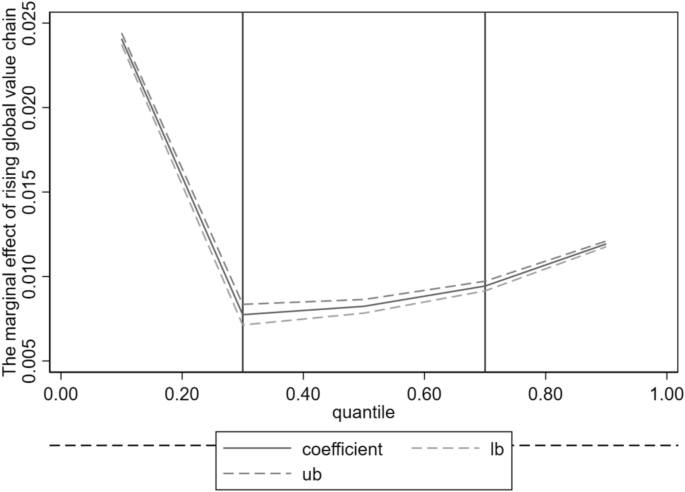
Quantile regression results of the upward effect of global value chain status.
The results in Figure 3 indicate that when the quantile position is between 10% and 30%, the marginal effect of industrial robot application is significantly positive, and the evolution trajectory shows a significant downward trend. When the quantile position is between 30% and 90%, the marginal effect of industrial robot application remains positive, but the evolution trajectory exhibits a slow upward trend. These results suggest that the marginal effect of industrial robot application is dynamically changing at different stages of GVC position development and shows a trend of first decreasing and then increasing. In industries with a lower GVC position, the impact of industrial robot application on the GVC position is stronger, which to some extent manifests as breaking the industry’s”low-end lock-in”.
link