
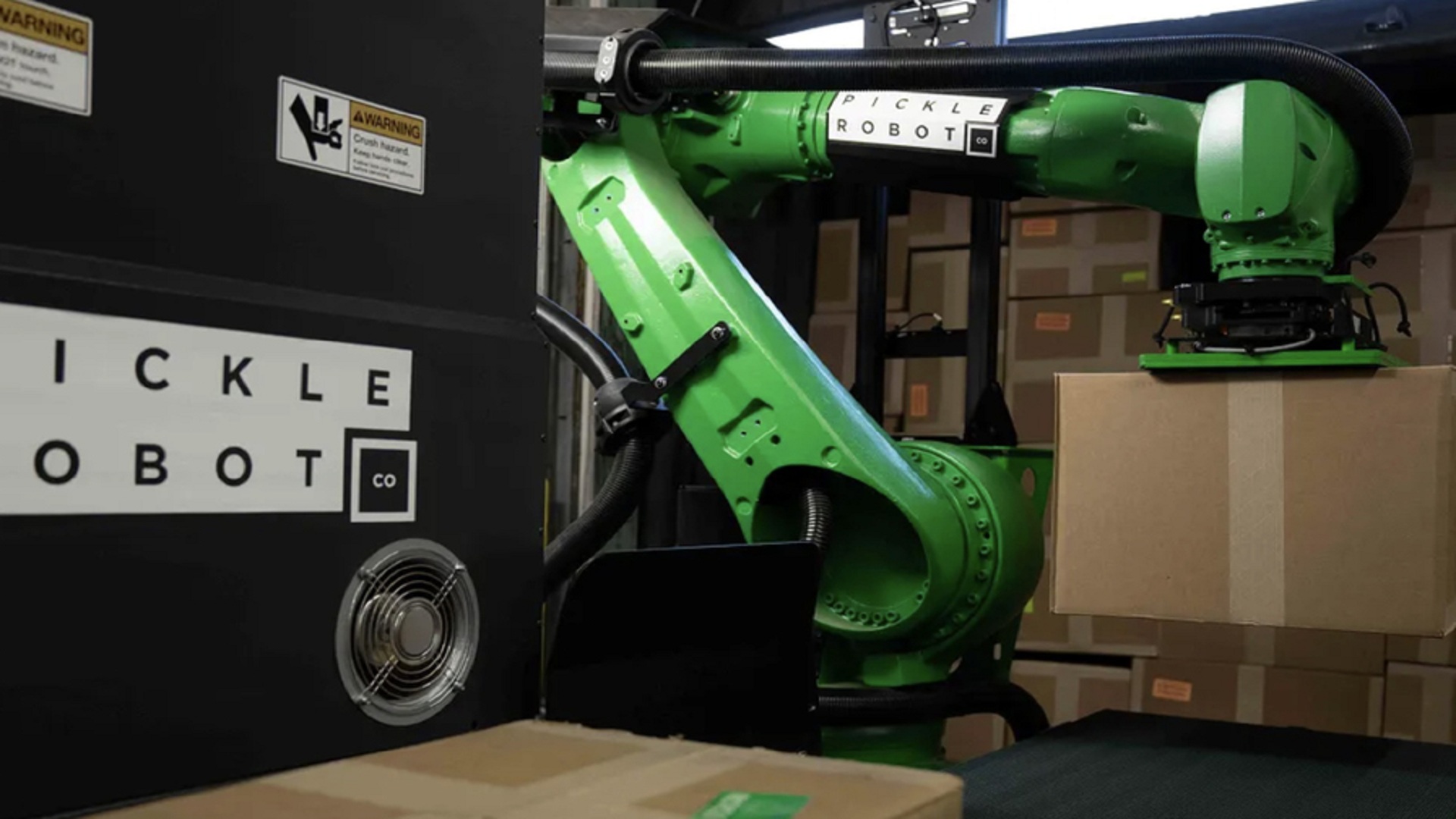
Humans have long struggled with one of logistics’ most punishing jobs: unloading scorching trailers packed with heavy boxes.
The work is exhausting, repetitive, and injury-prone. Now, robots are stepping in. The Pickle Robot Company’s AI-powered, one-armed machines can autonomously unload trucks, lifting boxes up to 50 pounds and feeding them onto conveyor belts.
They’re already in use with UPS, Ryobi Tools, and Yusen Logistics, reducing the physical toll on human workers.”
Founded by MIT alumni AJ Meyer, Ariana Eisenstein, and Dan Paluska, the robots combine generative AI, machine-learning algorithms, sensors, cameras, and machine-vision software.
The mix lets them navigate new warehouse environments “on day one” and fine-tune their performance over time.
Much of the company’s hardware comes from established industrial partners, including a bright pickle-green robotic arm you might usually find on car manufacturing lines.
Robot relief begins
Early customer deployments show that offloading humans from the brute-force, repetitive task of unloading trailers frees them to handle other bottlenecks.
“Humans are really good edge-case problem solvers, and robots are not,” Paluska says. He adds that there’s “so much drudgery we can get rid of.”
Meyer and Eisenstein didn’t initially team up at MIT. Their collaboration began later at a consultancy called Leaf Labs, where they worked on embedded systems for robots, cars, satellites — and even Google’s Project Ara. Eventually, though, they wanted to stop consulting and “do robots.”
By 2018, neural networks and algorithmic breakthroughs had finally made robotic dexterity and navigation less insurmountable.
The founders began surveying industries, including agriculture, food prep, hospitality, before landing in logistics warehouses, stopwatch in hand, to measure how long tasks took.
One visit to a UPS warehouse was decisive.
“In 2018, we went to a UPS warehouse and watched 15 guys unloading trucks during a winter night shift,” Meyer says. Worker turnover was extreme. The reason was simple: the job was backbreaking.
Building under pressure
The company initially built robots that sorted boxes, but the business wasn’t scaling. Funding dried up.
“We were desperately low on funds,” Meyer says.
So they pivoted. A quick proof-of-concept robot capable of unloading trucks for about 20 seconds went on YouTube, and hundreds of customers reached out. Investors returned.
Pickle piloted its first unloading system in a California desert warehouse, sparing workers from containers that reached 130°F in summer. Deployments soon expanded across U.S. logistics centers.
The system uses a KUKA arm mounted on a custom mobile base with onboard computing that lets it drive into trailers and reposition autonomously.
A suction gripper handles boxes ranging from small 5-inch cubes to 24×30-inch giants. Depending on size and weight, the robots unload 400 to 1,500 cases per hour. Pre-trained generative AI models, plus smaller control models, keep the workflow smooth.
The company is also developing software to connect robotic platforms ranging from humanoids to autonomous forklifts.
“What does it mean for the robot unloading a truck to talk to the robot palletizing?” Meyer asks.
Next chapter underway
Today, Pickle employs about 130 people in Charlestown, Massachusetts, where its green office opens into a warehouse test floor.
The team is ramping up production of its next system and plans to design a two-armed robot next.
“No one knows what they’re doing, so why not us?” Eisenstein says.
In the future, the startup plans to expand into manufacturing, retail, and the entire supply chain.
link