
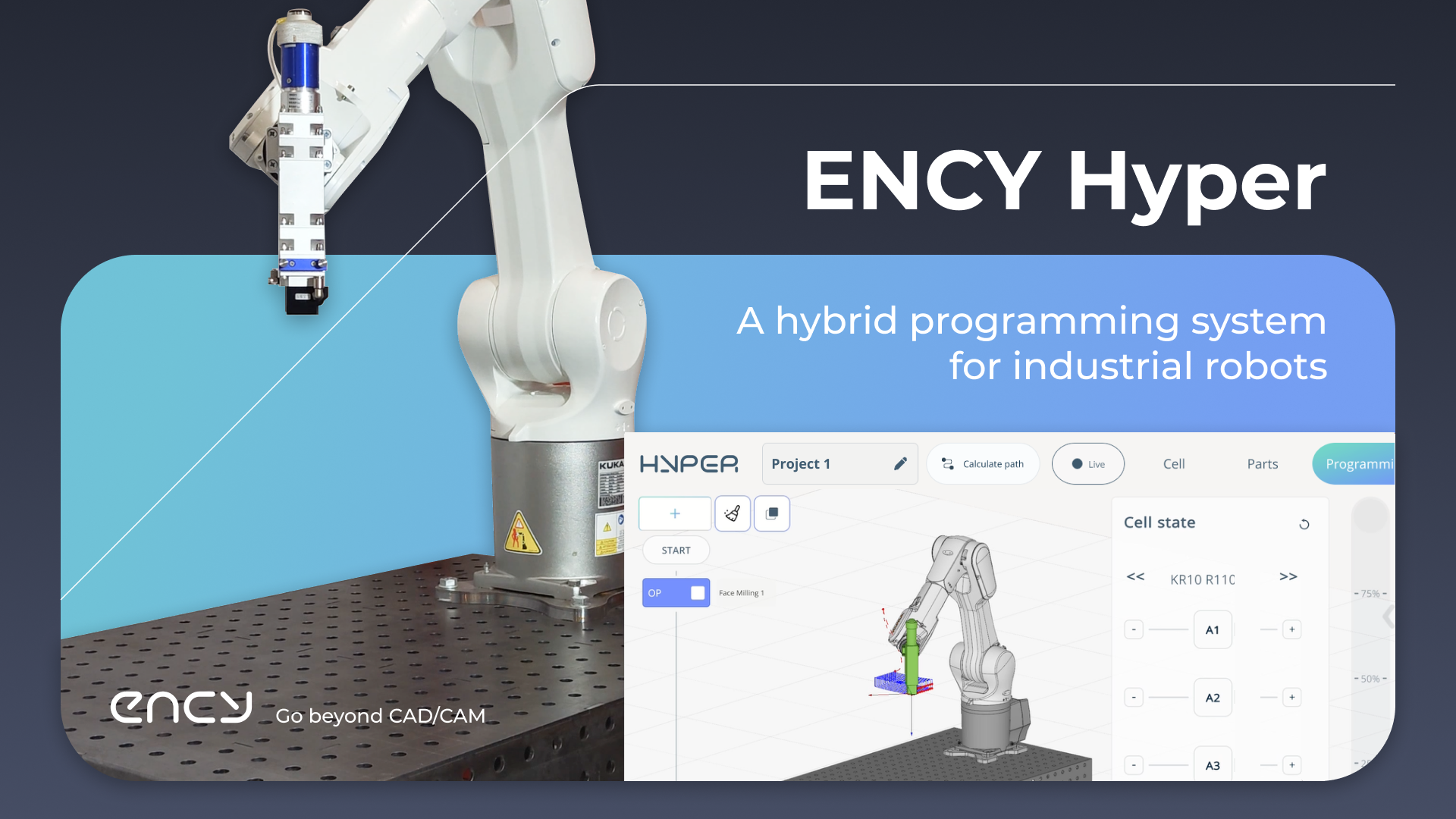
Hybrid, touch-optimized system blends digital-twin simulation with live robot communication to speed commissioning and enable on-cell programming.
ENCY Software has released ENCY Hyper, a system for programming and simulating industrial robots and auxiliary equipment. The platform combines offline programming with real-time methods in a workflow designed for tablets and industrial PCs. It will be presented at EMO Hannover 2025.

What ENCY Hyper offers
- Programming and simulation: A hybrid system for industrial robots and auxiliary equipment, combining offline programming with real-time operation in a touch-optimized workflow.
- Key capabilities: Real-time robot and sensor feedback, AI-assisted auxiliary tools, built-in collision avoidance, digital twin of the robotic cell, and multi-brand robot calibration from a single interface.
- Flexible use: Can operate independently for pick-and-place, palletizing, packaging, or assembly, or paired with ENCY Robot for tasks such as milling, welding, spraying, or grinding.
- Interactive environment: Communicates with the robot in real time, allowing immediate execution, testing, and adjustment of motion. Integrators and engineers can fine-tune control logic and motion from design through deployment.

Current challenges in robot programming
Online (teach-pendant) programming – Fast for simple adjustments and runs directly on the controller, but limited for complex paths. It depends on operator skill and visual judgment, lacks full-cell simulation, and requires testing on the actual cell, which can increase downtime.
Offline (CAM + simulation) – Allows precise path generation and verification in a digital twin, but small real-world variations (mounting offsets, gripper wear, tilted fixtures) can cause mismatches. Any on-cell changes require going back to the office to regenerate the program, transfer it to the robot, and test, repeating the process for each adjustment.
How ENCY Hyper addresses these issues
ENCY Hyper combines digital twin simulation with real-time robot communication in a single touch-optimized environment, preserving the advantages of both online and offline methods while reducing the limitations of each.
Addresses online (teach-pendant) limitations
- Scale without point-by-point teaching. Define what to pick and where to place; Hyper generates and executes motion in real time for routine tasks like pick-and-place, palletizing, packaging, or assembly.
- See before you move. Keep the responsiveness of online edits while gaining simulation of the complete robotic cell, so you’re not “testing blind” on production hardware.
- Safer, faster debugging. Stream commands to the controller, step through with live robot and sensor feedback, pause instantly, and resume safely.
Fixes offline (CAM + simulation) hand-off issues
- Eliminates the office↔cell loop. Instead of exporting, copying, and walking files back and forth, Hyper streams programs directly to the robot for immediate execution and on-the-spot adjustment.
- Closes the twin-to-reality gap. Use point-and-confirm calibration: show a few real pick/place points; Hyper updates the digital twin and automatically recalculates the rest.
- Built-in collision avoidance. As you adjust on the cell, Hyper continuously checks and generates obstacle-aware paths to keep edits safe.
- Multi-brand, one interface. Calibrate and program robots from different vendors through a single UI; add drivers to expand coverage without retooling your process.
- Right-sized effort for quick jobs. Skip heavyweight CAM rebuilds when you only need small changes; make them directly with immediate, real-time feedback.

Where ENCY Hyper delivers — from simple to complex
ENCY Hyper’s hybrid workflow applies from straightforward cells to advanced toolpaths, combining digital-twin confidence with live, on-cell execution. Examples below are illustrative, not exhaustive.
Simple operations
- Brownfield palletizing with drifting fixtures (6-axis robot on a 7th axis, palletizing/depalletizing) — Stream programs to the controller, tweak layer patterns at the cell, and quickly recalibrate offsets from a few real pick/place points; collision checks help maintain clearances near posts and guards.
- Kitting and light screwdriving (collaborative 6-axis cobot, assembly/screwdriving) — Nudge targets on a tablet and stream updated moves in real time; I/O feedback confirms each step without point-by-point reteaching.

Advanced operations (with ENCY Robot)
All functions programmed in ENCY Robot can be executed in ENCY Hyper. The main difference is where adjustments are made: directly at the robot, without returning to the office. Operators and engineers can modify part positions, approaches, exits, batch size, tray or box destinations, step size, and number of passes interactively in Hyper. For a new part, the CAM project is updated in ENCY Robot; for routine production changes on the same part, Hyper is used.
- Robot milling (6-axis robot, optional linear 7th axis; spindle) — Programs are generated in ENCY Robot and tuned on the floor in Hyper (approach/exit edits, feeds, local adjustments).
- Grinding/polishing/deburring (6-axis robot; abrasive/finishing tools) — Generate toolpaths in ENCY Robot; in Hyper, adjust passes, step size, and approach/exit moves interactively next to the robot.
- Coating/painting (6-axis robot + rotary table) — Use ENCY Robot for path definition; in Hyper, refine process parameters like number of passes and start/stop timing at the cell.
- Arc welding (6-axis robot + 2-axis positioner; GMAW/TIG) — Define and simulate in ENCY Robot; at the cell, Hyper lets you adjust weld parameters such as weave step, pass length, and strategy without rebuilding the CAM project.
By combining online and offline workflows, ENCY Hyper streamlines commissioning, supports flexible short runs and changeovers, and helps reduce downtime. It benefits manufacturing and robotics engineers (enabling design-to-deployment adjustments), shop-floor operators and technicians (guided on-cell edits without point teaching), system integrators (shorter FAT/SAT cycles, fewer site visits), and OEMs/machine builders (consistent multi-brand workflows and simplified field updates).
For more information, visit encycam.com.
link