
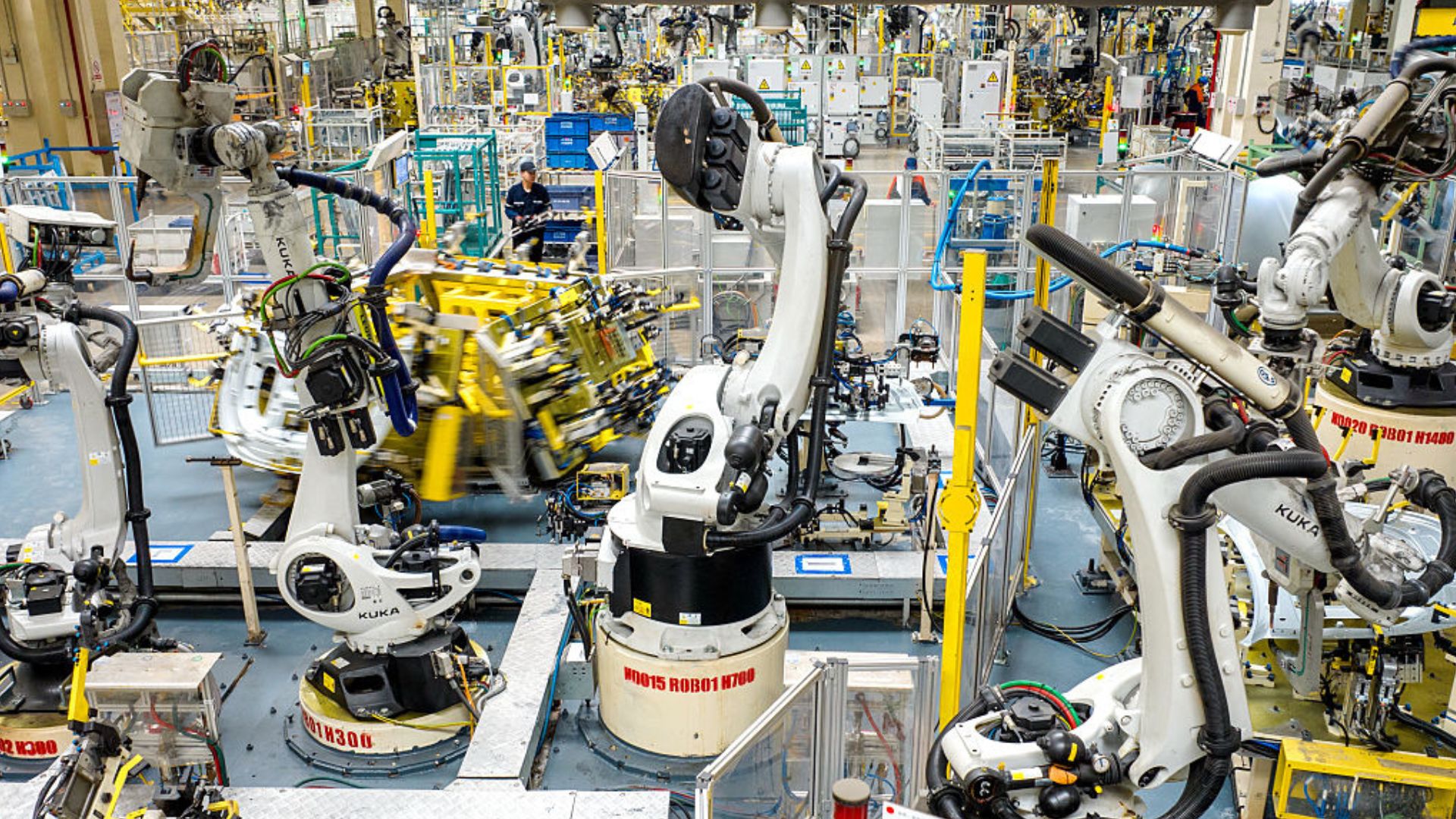
China increased its industrial robot installations in 2024 even as major global markets saw declines, according to preliminary data from the International Federation of Robotics (IFR).
The country recorded a 5 per cent rise to about 290,000 units, accounting for 54 per cent of the world’s total, up from 51 per cent in 2023. In contrast, the global installation volume fell to around 520,000 units.
Japan’s installations dropped 7 per cent to 43,000 units, the United States posted a 9 per cent fall to 34,000 units, and the European Union registered a 6 per cent decrease to 86,000 units. IFR President Takayuki Ito said at the World Robot Conference in Beijing on Saturday that “for the past four years, new installations in China are trending more or less sideways.”
South China Morning Post (SCMP) reports that the growth comes as China accelerates efforts to upgrade its manufacturing chain through automation, part of a broader push to shift from a labour-intensive growth model to one driven by technology.
In the first half of 2025 alone, China’s industrial robot production surged 35.6 per cent year on year, reaching nearly 370,000 units, according to the National Bureau of Statistics of China.
Rising global rank in robot density
China has climbed rapidly in global rankings for robot density, the number of industrial robots operating per 10,000 workers. IFR data shows the figure nearly doubled from 246 in 2020, when China ranked ninth worldwide, to 470 in 2023, moving the country up to third place behind South Korea and Singapore.
Adopting industrial robots in China is also broadening beyond traditional strongholds like electronics and automotive manufacturing. The SCMP report mentions that Installations in general industries represented 53 per cent of the total in 2024, compared to 38 per cent in 2020, while the electronics sector’s share dropped from 45 per cent to 28 per cent.
Despite challenges from geopolitical uncertainties and tariffs, Ito said the regional outlook remains positive.
“It is expected [that] the modernisation and improvement with economic resilience will continue in [China’s] next five-year plan. This will then increase robot demand since the new production capacity in various industries needs to be built up,” he said. “China will remain a major market for industrial robotics.”
Humanoid and embodied AI push
Alongside growth in industrial robots, China is stepping up investments in humanoid and embodied artificial intelligence (AI) technologies. This week, Beijing unveiled what it calls the world’s first “Robot Mall,” a 4S-style retail space dedicated exclusively to robots.
The format, offering sales, service, spare parts, and customer feedback, mirrors the model used in China’s car dealerships but focuses entirely on humanoid products for the public.
Local governments are also promoting embodied AI, which integrates artificial intelligence into physical entities like robots, enabling them to perceive, learn, and interact with their environment.
On Wednesday, Shanghai released an action plan to develop its embodied AI industry, following a similar initiative by Shenzhen in March.
Shenzhen’s plan aims for an industrial output of over 100 billion yuan by 2027, leveraging its dense network of AI companies and its strong manufacturing base. The city, known as China’s “Silicon Valley,” intends to use its industrial chain to accelerate robotics innovation and adoption.
Despite external headwinds, ongoing modernisation efforts and government-backed initiatives indicate that the country is positioning itself at the forefront of automation and robotics for years to come.
link