


:quality(90)/p7i.vogel.de/wcms/06/ab/06abc91cf666f302f2c233da44c20faf/0118674360v1.jpeg "What advances the development of industrial robots")
Highly integrated embedded processors
What advances the development of industrial robots
Source:
Texas Instruments | Translated by AI
Related Vendor
Highly integrated embedded processors contain a variety of different components. In addition, they are more energy efficient and generate less heat. These characteristics can advance the development of industrial robots.

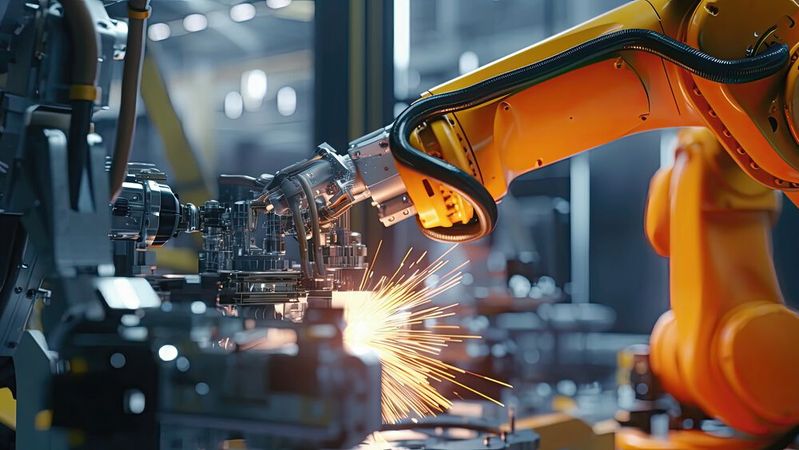
(Image: Adobe Stock)
Driven by advances in semiconductor technology and growing demand for ever smarter, safer, and more efficient systems, industrial robots have undergone impressive development over the past few years. Embedded processors based on SoC architectures (System-on-Chip), which include various components such as peripheral functions or accelerators, are a central element. As a result, industrial robots are better able to perform their tasks quickly, precisely, and reliably.
Embedded processors control the movements of the robot arms
Industrial robots are used for a wide variety of tasks, from simple assembly operations to complex manufacturing processes such as welding or painting.
Gallery
Embedded processors control the movements of the robot arms and associated actuators, process data collected from various sensors, and make decisions based on feedback received from the environment. This gives the robots more precision, efficiency, and autonomy, which not only benefits productivity, but also reduces the need for human intervention in industrial processes.
Highly integrated embedded processors such as the AM68A, AM69A, TDA4VM, and TDA4VH-Q1 types from Texas Instruments (TI) typically include the CPU, memory, I/O interfaces, special hardware accelerators, and image processing processors, making them suitable for a broad range of tasks ranging from motion control, sensor data processing, communication to real-time decision making.
Highly integrated embedded processors generate less heat
Compared to discrete solutions, higher integrated embedded processors are more energy efficient and generate less heat, which is of great importance in industrial applications. If the computer block of a robot consumes less power, then either more energy is available to other important systems, or the overall system’s energy demand can be reduced to make the robot more energy efficient. In battery-operated robots, embedded processors with sophisticated power management features will also help to extend battery run times or battery life.
Finally, increased integration also simplifies the entire system design, and performance benefits from the fact that the individual components of a robot can be configured at a shorter distance, which reduces data transmission times as well as cabling effort. Cost and weight savings are the result.
Intelligent and autonomous robots
The more intelligent and autonomous robots become and the more reliably they can work with humans (keyword: cobot), the more highly integrated embedded processors will be used in industrial robots. Further development will focus on increasing the performance, energy efficiency and safety of embedded processors and integrating new technologies. In particular, artificial intelligence and machine learning will be incorporated into more and more robot control systems. Continuous innovation and development will ensure that highly integrated embedded processors will play a defining role in the future of industrial robots.
TI is a leading provider of highly integrated embedded processors for industrial robots. The portfolio includes a wide range of components that are specifically tailored to the high demands of industrial automation. In combination with open-source software from the TI Developer Zone and a large inventory of external hardware and software partners, these building blocks help to drive innovation and increase the proliferation of robots in the industrial sector by simplifying the design process.
This article was first published on our sister website ‘AT – Aktuelle Technik’ (Suisse Edition), Vogel Communications Group
Stand vom 23.03.2021
Naturally, we always handle your personal data responsibly. Any personal data we receive from you is processed in accordance with applicable data protection legislation. For detailed information please see our privacy policy.
Consent to the use of data for promotional purposes
I hereby consent to Vogel Communications Group GmbH & Co. KG, Max-Planck-Str. 7/9, 97082 Würzburg, Germany, including any affiliated companies according to §§ 15 et seq. AktG (hereafter: Vogel Communications Group) using my e-mail address to send editorial newsletters. A list of all affiliated companies can be found here
Newsletter content may include all products and services of any companies mentioned above, including for example specialist journals and books, events and fairs as well as event-related products and services, print and digital media offers and services such as additional (editorial) newsletters, raffles, lead campaigns, market research both online and offline, specialist webportals and e-learning offers. In case my personal telephone number has also been collected, it may be used for offers of aforementioned products, for services of the companies mentioned above, and market research purposes.
In case I access protected data on Internet portals of Vogel Communications Group including any affiliated companies according to §§ 15 et seq. AktG, I need to provide further data in order to register for the access to such content. In return for this free access to editorial content, my data may be used in accordance with this consent for the purposes stated here.
Right of revocation
I understand that I can revoke my consent at will. My revocation does not change the lawfulness of data processing that was conducted based on my consent leading up to my revocation. One option to declare my revocation is to use the contact form found at In case I no longer wish to receive certain newsletters, I have subscribed to, I can also click on the unsubscribe link included at the end of a newsletter. Further information regarding my right of revocation and the implementation of it as well as the consequences of my revocation can be found in the data protection declaration, section editorial newsletter.
link